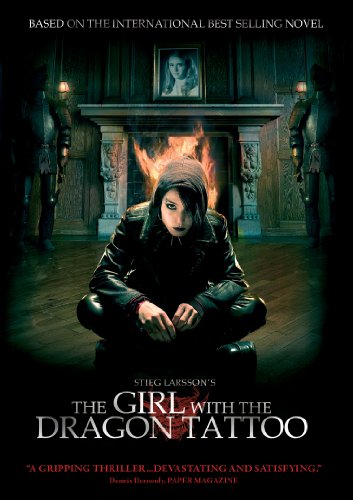
Movie Info
Movie Year:
Cast:
Screenplay:
Genre:
Thriller,
Drama,
Studio:
Others
Genre:
Action/Adventure
Other
Horror/Suspense
Television
Romance
Sci-Fi/Fantasy
Thriller
Animation
Comedy
Documentary
Drama
Kids/Family
Studio:
Blu-ray Release:
No release information.
Blu-ray 3D Release:
No release information.
DVD Release:
(ex. 2002/10/21)
Synopsis:
Tagline:
No Tagline yet. Add
Feb 08, 2012
Few directors shoot the machinations of a MacBook with as much flair as David Fincher. As the characters in “The Girl with the Dragon Tattoo” shuffle ...
Few directors shoot the machinations of a MacBook with as much flair as David Fincher. As the characters in “The Girl with the Dragon Tattoo” shuffle through clues in a glossy iPhoto spread or consult Wikipedia for case research, their actions look dynamic and elegant, the digital evidence as visually well-defined as its tactile incarnations. This is an achievement of some significance, as an ever-advancing computer age has been gradually diminishing the look and feel of the thriller for decades. It errs in many ways, some unforgivable, but “The Girl with the Dragon Tattoo” will always have this: It makes Google-sleuthing interesting to look at. This may be its lasting legacy.
It’s certainly its least offensive or contentious quality. Much about “The Girl with the Dragon Tattoo” ultimately works or doesn’t depending on your perspective, which is why opinions oscillate between celebration and revulsion. Critics of Stieg Larssen’s trilogy of novels (as well as the Swedish cinematic adaptations which followed) tended to lean toward the latter reaction, citing the work’s ham-fisted style and thinly veiled misogyny as reasons for the prompt dismissal of the phenomenon. The accepted awfulness of the source material notwithstanding, expectations for Fincher’s American iteration were naturally quite high, as they would be for anybody following up a film as widely acclaimed as last year’s “The Social Network.” The resulting reactions have been mixed. For some, Fincher has elevated trash to something close to art, while for others he’s simply strained to polish a turd.
Fincher’s done about as well as could be expected, given the limitations of the material. The basics remain largely in tact, and will be familiar to most: discredited journalist Mikael Blomkvist partners with Lisbeth Salander (played with admirable intensity and insight by a revelatory Rooney Mara), the aggressively unique post-feminist heroine of the series, and together they endeavor to solve a sub-Agatha Christie mystery involving mega-rich Nazi rapists, or something. But, mercifully, Fincher’s been granted the aesthetic freedom to color outside the lines of the novel, and his palette is as rich and interesting as ever; the problem is that the lines form a irredeemably terrible drawing, and Fincher just can’t do anything about it. The style we’ve come to expect is there, and it looks and sounds immaculate. But because this is a rote and hackneyed procedural, it still ultimately feels like a rote and hackneyed procedural—its every gesture a cliche, its every revelation predictable. By the time the cartoonish serial killer reveals his master plan before intending to torture and murder the kidnapped protagonist, you’re not even surprised or disappointed that he actually says, in earnest, “We’re not so different, you and I.”
Which isn’t to say that the work is entirely bereft of interest. Many of the themes which have dominated Fincher’s filmography—the mutability of gender and identity, the social implications of technology, the instability of truth—have wormed there way into the film, and I suspect their presence at the periphery of the source material may have been Fincher’s impetus for pursuing the project to begin with. Clearly Salander, an overtly interesting character, provides the film with a number of opportunities to distinguish itself thematically as well as aesthetically. But in the end, Salander’s little more than a mercifully three-dimensional character lost in a film full of cardboard cutout antagonists.
“The Girl With The Dragon Tattoo” is considerably more valuable as the subject of critical debate and discussion than it is any kind of entertainment, and that’s what’s most frustrating. This is, of course, intended to be a thriller, and it must therefore be to its detriment that it only bores. Fincher has devised a method of filming his characters as they use computers in a way which looks infinitely preferable to styles exhausted before, but tedious detective legwork is still just that: the film never transcends its basic procedural tedium, focusing on style at the edges when it should be concerned with the cliches at its core.
Exposition is unloaded in excess, characters are introduced and promptly forgotten, and questions we don’t understand yield answers we don’t care about. People stare at photographs, at computer monitors, at the middle distance; everyone speaks in platitudes, even when Fincher seems to have something to say. An the opening title sequence looks like it’s on loan from the next Bond movie. “The Girl with the Dragon Tattoo” is at odds with itself, its well-intentioned and creative and genuinely interesting qualities running totally counter to the great many things about it that are very, very wrong.
==Written by Calum Marsh==
==From: In Review Online (www.inreviewonline.com)==
It’s certainly its least offensive or contentious quality. Much about “The Girl with the Dragon Tattoo” ultimately works or doesn’t depending on your perspective, which is why opinions oscillate between celebration and revulsion. Critics of Stieg Larssen’s trilogy of novels (as well as the Swedish cinematic adaptations which followed) tended to lean toward the latter reaction, citing the work’s ham-fisted style and thinly veiled misogyny as reasons for the prompt dismissal of the phenomenon. The accepted awfulness of the source material notwithstanding, expectations for Fincher’s American iteration were naturally quite high, as they would be for anybody following up a film as widely acclaimed as last year’s “The Social Network.” The resulting reactions have been mixed. For some, Fincher has elevated trash to something close to art, while for others he’s simply strained to polish a turd.
Fincher’s done about as well as could be expected, given the limitations of the material. The basics remain largely in tact, and will be familiar to most: discredited journalist Mikael Blomkvist partners with Lisbeth Salander (played with admirable intensity and insight by a revelatory Rooney Mara), the aggressively unique post-feminist heroine of the series, and together they endeavor to solve a sub-Agatha Christie mystery involving mega-rich Nazi rapists, or something. But, mercifully, Fincher’s been granted the aesthetic freedom to color outside the lines of the novel, and his palette is as rich and interesting as ever; the problem is that the lines form a irredeemably terrible drawing, and Fincher just can’t do anything about it. The style we’ve come to expect is there, and it looks and sounds immaculate. But because this is a rote and hackneyed procedural, it still ultimately feels like a rote and hackneyed procedural—its every gesture a cliche, its every revelation predictable. By the time the cartoonish serial killer reveals his master plan before intending to torture and murder the kidnapped protagonist, you’re not even surprised or disappointed that he actually says, in earnest, “We’re not so different, you and I.”
Which isn’t to say that the work is entirely bereft of interest. Many of the themes which have dominated Fincher’s filmography—the mutability of gender and identity, the social implications of technology, the instability of truth—have wormed there way into the film, and I suspect their presence at the periphery of the source material may have been Fincher’s impetus for pursuing the project to begin with. Clearly Salander, an overtly interesting character, provides the film with a number of opportunities to distinguish itself thematically as well as aesthetically. But in the end, Salander’s little more than a mercifully three-dimensional character lost in a film full of cardboard cutout antagonists.
“The Girl With The Dragon Tattoo” is considerably more valuable as the subject of critical debate and discussion than it is any kind of entertainment, and that’s what’s most frustrating. This is, of course, intended to be a thriller, and it must therefore be to its detriment that it only bores. Fincher has devised a method of filming his characters as they use computers in a way which looks infinitely preferable to styles exhausted before, but tedious detective legwork is still just that: the film never transcends its basic procedural tedium, focusing on style at the edges when it should be concerned with the cliches at its core.
Exposition is unloaded in excess, characters are introduced and promptly forgotten, and questions we don’t understand yield answers we don’t care about. People stare at photographs, at computer monitors, at the middle distance; everyone speaks in platitudes, even when Fincher seems to have something to say. An the opening title sequence looks like it’s on loan from the next Bond movie. “The Girl with the Dragon Tattoo” is at odds with itself, its well-intentioned and creative and genuinely interesting qualities running totally counter to the great many things about it that are very, very wrong.
==Written by Calum Marsh==
==From: In Review Online (www.inreviewonline.com)==
Jan 26, 2012
If one would recall back to my review of the 2009 Swedish film The Girl with the Dragon Tattoo, I expressed my worry of the upcoming American renditio ...
If one would recall back to my review of the 2009 Swedish film The Girl with the Dragon Tattoo, I expressed my worry of the upcoming American rendition of the film. My worry was for good reason. The Swedish film had a profound effect on me, and its star Noomi Rapace left an everlasting impression. How was I to handle the idea of a new cast and possible new take on the story?
I have to say I was pleasantly surprised. What first stood out was that there were quite a few differences in this rendition. One of my worries was that it would be a shot-for-shot remake of the Swedish film, sort of like Let Me In (also based on a Swedish novel and film, Let the Right One In). This was not the case, and made me very excited once I started noticing this.
The second thing that took me by surprise was the Rooney Mara was quite impressive as Lisbeth Salander, the complex techie misfit. While Noomi Rapace and her portrayal of Lisbeth will always have a special place with me, Mara’s take on the challenging role earned huge points in my book. Even the Swedish accent she had to take on for this film was consistent and sounded convincing.
When I saw the Swedish film, I was enthralled in the story and its heroine. I just had to have more of it, so part of me was looking forward to a new rendition just to be able to relive the story once again. The differences with the story gave me many reasons to enjoy this film and still feel the spirit and mystery with the tale.
In regards to the story itself, it follows Mikael Blomkvist (Daniel Craig), a journalist set out to expose the corrupted, who is sentenced for libel. He’s propositioned by an elder of a rich family to solve the mystery of a missing niece. Blomkvist gets deep into the family’s dark secrets. Meanwhile Lisbeth Salander, a leather-clad computer geek turned badass, is through unusual circumstances brought together with Blomkvist and the two form an unlikely team.
It’s a story of men who hate women (which happens to be the Swedish title of the book and film), and two unique individuals with very different personalities who are also alike in so many ways. It is a dark and mysterious adventure that has the viewer feeling intrigued, excited, scared, and disgusted. On that note, one of my only complaints about the film was there may be a few exploitative and unnecessarily graphic scenes which do indeed get very emotional responses from the audience. While they may be accurate to the source material, seeing it is different than imagining it…but I’ll refrain from ranting.
I thought by seeing the film once, it was over, but David Fincher’s vision managed to give me a fresh new look at the same characters and story from a few different angles. The film is cool and stylish, and carries over the dark and bleakness of the snowy Swedish countryside that was so effective in the Swedish film. Now if they do what they did with this film on the two sequels, than I think we’re in for yet another fun retelling of the story that has been taking over the world by storm.
I have to say I was pleasantly surprised. What first stood out was that there were quite a few differences in this rendition. One of my worries was that it would be a shot-for-shot remake of the Swedish film, sort of like Let Me In (also based on a Swedish novel and film, Let the Right One In). This was not the case, and made me very excited once I started noticing this.
The second thing that took me by surprise was the Rooney Mara was quite impressive as Lisbeth Salander, the complex techie misfit. While Noomi Rapace and her portrayal of Lisbeth will always have a special place with me, Mara’s take on the challenging role earned huge points in my book. Even the Swedish accent she had to take on for this film was consistent and sounded convincing.
When I saw the Swedish film, I was enthralled in the story and its heroine. I just had to have more of it, so part of me was looking forward to a new rendition just to be able to relive the story once again. The differences with the story gave me many reasons to enjoy this film and still feel the spirit and mystery with the tale.
In regards to the story itself, it follows Mikael Blomkvist (Daniel Craig), a journalist set out to expose the corrupted, who is sentenced for libel. He’s propositioned by an elder of a rich family to solve the mystery of a missing niece. Blomkvist gets deep into the family’s dark secrets. Meanwhile Lisbeth Salander, a leather-clad computer geek turned badass, is through unusual circumstances brought together with Blomkvist and the two form an unlikely team.
It’s a story of men who hate women (which happens to be the Swedish title of the book and film), and two unique individuals with very different personalities who are also alike in so many ways. It is a dark and mysterious adventure that has the viewer feeling intrigued, excited, scared, and disgusted. On that note, one of my only complaints about the film was there may be a few exploitative and unnecessarily graphic scenes which do indeed get very emotional responses from the audience. While they may be accurate to the source material, seeing it is different than imagining it…but I’ll refrain from ranting.
I thought by seeing the film once, it was over, but David Fincher’s vision managed to give me a fresh new look at the same characters and story from a few different angles. The film is cool and stylish, and carries over the dark and bleakness of the snowy Swedish countryside that was so effective in the Swedish film. Now if they do what they did with this film on the two sequels, than I think we’re in for yet another fun retelling of the story that has been taking over the world by storm.
Fans of Stieg Larsson's Men Who Hate Women may have been concerned about how the Swedish author's novel would translate to the screen, but they needn't have worried. Significant changes to the source material have been made, but director Niels Arden Opley's The Girl with the Dragon Tattoo, as it's now called, is mostly riveting. As the story begins, middle-aged investigative journalist Mikael Blomkvist (Michael Nyqvist) has just been convicted of a bogus charge of libel against a rich and corrupt corporate hotshot when he's unexpectedly offered a most unusual gig. An aging captain of industry named Henrik Vanger (Sven-Bertil Taube) wants Blomkvist to figure out what happened to Vanger's niece, who disappeared more than 40 years earlier; not only is the old man convinced that she was murdered, but he suspects that another member of his large and rather disagreeable family (which includes several former Nazis) is the culprit. Blomkvist takes the job, which includes spending at least six months on Vanger's isolated island in the middle of winter. But what he doesn't know is that he's being spied on by twentysomething Lisbeth Salander (brilliantly played by Noomi Rapace in a career-making performance), the titular Girl and the possessor of remarkable skills as a sleuth and computer hacker. With her gothlike piercings and all-black clothes, Lisbeth is a vivid character, to say the least. While we don't exactly know the details of her dark past, it's obviously still with her; indeed, she's just been assigned a new "guardian" (like a parole officer) to look after her finances and other matters. We also know that she is not someone to mess with; when the guardian turns out to be a thoroughly vile monster, Lisbeth gets back at him in one of the more satisfying revenge sequences in recent memory. That Lisbeth and Mikael should end up working together, and more, isn't especially surprising. But the horrifying details and depths of depravity they uncover while working on the case (parallels to The Silence of the Lambs are facile but appropriate) definitely are, and Opley does a nice job of keeping it all straight. At more than two and a half hours, the film is long, with its share of grim, graphic, and scary moments, but The Girl with the Dragon Tattoo is a winner. --Sam Graham
Movie Disc Details
No Movie Disc Detail yet.