Movie Info
Movie Year:
Cast:
Brad Pitt
,
Jonah Hill
,
Chris Pratt
,
Tammy Blanchard
,
Philip Seymour Hoffman
,
Kathryn Morris
,
Robin Wright
Screenplay:
Genre:
Kids/Family,
Other,
Drama,
Studio:
Sony Pictures Classics
Genre:
Action/Adventure
Other
Horror/Suspense
Television
Romance
Sci-Fi/Fantasy
Thriller
Animation
Comedy
Documentary
Drama
Kids/Family
Studio:
DVD Release:
2012/01/10
Theater Release:
2011/09/23
Blu-ray Release:
2012/01/10
Blu-ray 3D Release:
No release information.
DVD Release:
(ex. 2002/10/21)
Synopsis:
Tagline:
No Tagline yet. Add

Feb 02, 2012
This is the true story of Billy Beane (Brad Pitt) general manager of the Oakland A’s baseball team in 2002 when he was faced with the lowest pool of m ...
This is the true story of Billy Beane (Brad Pitt) general manager of the Oakland A’s baseball team in 2002 when he was faced with the lowest pool of money in professional baseball, but expected to put together a team. He met young college grad Peter Brand (Jonah Hill) and immediately hired him when he was told his theory of how to put together a team on a budget. Facing harsh criticism, both from the insiders of baseball, and from the fans and media, they used a computer model to develop a team of under-rated players that they could afford, and in the process had a shot at securing the longest winning streak in baseball, after a lot of resistance, especially from manager Art Howe (Phillip Seymour Hoffman).
If you are a baseball fan, then you have to see this film! I have been waiting for quite a while to see it. This is a true story, and it’s a typical sports amazing achievement film, but it’s a really good look into baseball, and the problems of the “have-not” teams. Baseball has always had a serious problem, which I think is the cause of their great fall from grace as “America’s National Game”. Baseball never figured out how to even the field, with a couple teams from HUGE cities with a giant payroll competing with tiny teams that love the sport, but have a fraction of the money to spend. I spent my childhood as a Pirates fan, but got really tired of one of the greatest farm systems finding all the superstars and developing them for the Yankees, and a couple other big teams that always stole them. The few successful years they had was due to the great scouts and farm system finding excellent players for a year or two until someone with deep pockets would take them away.
This movie is the story of a system that reminded me a lot of horse racing. The very best horse handicapper is the public. The favorite wins way more than it loses. Sure bets at 6-5 and less go off every day. In order to be successful in the horse racing business, it’s finding the horses that are undervalued and underrated. You have to study hard, and find that one or two races a day where there is a horse with a decent chance to win that somehow people have overlooked. That’s the secret. Well, the same is true with baseball. Some of the players are undervalued and underrated, and this mathematical formula helped to take all the emotion out of it. (This guy has a funny swing, or the way he throws the ball looks off, or he looks like a doofus), and uses the stats and rates him based upon things the other teams never looked at. It also requires a carnival barkers skill at scamming the other teams to make them think you’re doing them a favor by taking their unwanted players.
Brad Pitt did an excellent job in this movie. This is a perfect role for him, and I think he pulled it off. I know Jonah Hill was also very proud of this role as well. He played a very serious dramatic role, and got to show off his new svelte physique. Not only did he pull off a serious role, (no Superbad nonsense here at all), but he did an excellent job. Phillip Seymour Hoffman is also very good as the manager who just can’t get what these dudes are thinking. It’s a small role for him, but as usual, he was spot on. Basically this is a very interesting movie, and the time passes very quickly and it’s over before you’d like it to be. It’s got a fair amount of baseball action, that is easy to watch, but also has some great dialog and dramatic scenes that are also very well done. I enjoyed this movie all around, and recommend it to anyone who is interested in the genre, or those who just love to look at Brad Pitt.
==Written by Ed Goettman ==
==From: Ed's Review Dot Com (www.edsreview.com)==
If you are a baseball fan, then you have to see this film! I have been waiting for quite a while to see it. This is a true story, and it’s a typical sports amazing achievement film, but it’s a really good look into baseball, and the problems of the “have-not” teams. Baseball has always had a serious problem, which I think is the cause of their great fall from grace as “America’s National Game”. Baseball never figured out how to even the field, with a couple teams from HUGE cities with a giant payroll competing with tiny teams that love the sport, but have a fraction of the money to spend. I spent my childhood as a Pirates fan, but got really tired of one of the greatest farm systems finding all the superstars and developing them for the Yankees, and a couple other big teams that always stole them. The few successful years they had was due to the great scouts and farm system finding excellent players for a year or two until someone with deep pockets would take them away.
This movie is the story of a system that reminded me a lot of horse racing. The very best horse handicapper is the public. The favorite wins way more than it loses. Sure bets at 6-5 and less go off every day. In order to be successful in the horse racing business, it’s finding the horses that are undervalued and underrated. You have to study hard, and find that one or two races a day where there is a horse with a decent chance to win that somehow people have overlooked. That’s the secret. Well, the same is true with baseball. Some of the players are undervalued and underrated, and this mathematical formula helped to take all the emotion out of it. (This guy has a funny swing, or the way he throws the ball looks off, or he looks like a doofus), and uses the stats and rates him based upon things the other teams never looked at. It also requires a carnival barkers skill at scamming the other teams to make them think you’re doing them a favor by taking their unwanted players.
Brad Pitt did an excellent job in this movie. This is a perfect role for him, and I think he pulled it off. I know Jonah Hill was also very proud of this role as well. He played a very serious dramatic role, and got to show off his new svelte physique. Not only did he pull off a serious role, (no Superbad nonsense here at all), but he did an excellent job. Phillip Seymour Hoffman is also very good as the manager who just can’t get what these dudes are thinking. It’s a small role for him, but as usual, he was spot on. Basically this is a very interesting movie, and the time passes very quickly and it’s over before you’d like it to be. It’s got a fair amount of baseball action, that is easy to watch, but also has some great dialog and dramatic scenes that are also very well done. I enjoyed this movie all around, and recommend it to anyone who is interested in the genre, or those who just love to look at Brad Pitt.
==Written by Ed Goettman ==
==From: Ed's Review Dot Com (www.edsreview.com)==
Dec 09, 2011
You don’t have to be a baseball-geek, a statistics junkie, or a Brad Pitt fanatic to love “Moneyball”—but it doesn’t hurt. Admittedly, I fall squarely ...
You don’t have to be a baseball-geek, a statistics junkie, or a Brad Pitt fanatic to love “Moneyball”—but it doesn’t hurt. Admittedly, I fall squarely into one of those categories, and I couldn’t take my eyes off this film: working from a script by Aaron Sorkin and Steven Zaillian, director Bennett Miller crafts a funny, thoughtful biopic that transcends the baseball diamond and delves deep into one man’s soul. Based on the 2003 bestseller by Michael Lewis, “Moneyball” dissects the exploits of Oakland A’s General Manager Billy Beane as he attempts to revolutionize baseball and level the playing field.
The film opens in 2002, and we watch as the New York Yankees, the team with the highest payroll in baseball, beat the A’s, a team with one of the lowest payrolls. Sick of losing and painfully aware of small market economics, Beane gets creative. For the uninitiated, Beane changed the way his players were evaluated, tossing out the subjective “intangibles” most baseball scouts used to determine value and moving to statistical analysis, focused on which players scored the most runs. Sounds scintillatingly cinematic, right? But Miller’s astute filmmaking combines sleek camerawork and editing with subtle sound design to capture the real world drama of drafting players, creating lineup cards and scouring on-base-percentages.
While the book spends copious pages on detailed baseball numbers, Miller focuses squarely on the human angle, shining a light on Pitt as Beane. And Pitt's fantastic in the role: he carries the full weight of the story with charisma and depth, finding the emotional intensity of this lonely, driven man, battling against a system that betrayed him. You see, Beane was a teenage baseball phenom promised the world by baseball scouts, but after six below-average seasons playing for four teams, his on-field career was over, his promise never fully realized. Miller focuses on the sting of that backstory to illuminate Beane’s obsessive need to remove messy emotional connections from the measuring of baseball talent, relying instead on the comforting clinical science of numbers.
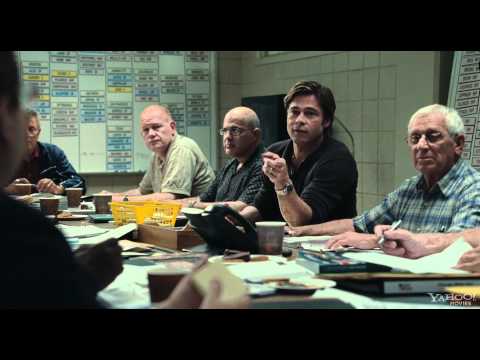
Jonah Hill plays Beane’s spiritual guide of statistics, Peter Brand (a fictional name for former A’s assistant GM Paul De Podesta). Understated and authentic, Hill delivers his best performance yet, reaching beyond the sarcastic stoner persona we’ve come to enjoy in those Apatow joints. Hill is funny and sympathetic as a fish-out-of-water Yale-educated economics major suddenly surrounded by salty baseball scouts. His early scenes, sitting around the table with baseball vets three times his age, are priceless; his mere presence represents an alien mindset in a world where tradition and routine drive almost every decision and idea. Watching these personalities collide creates a consistently surprising buzz that sustains throughout.
Despite the film’s “sports movie” status, “Moneyball” moves at a surprisingly languid pace. That’s a compliment—Miller takes care to focus on small, meaningful moments, never striving for over-the-top “Field of Dreams” schmaltz. Like Beane himself, the film strives to be honest and cut through the crap associated with sports-themed biopics. Of course, there are feel good moments: a dramatic homerun, a player’s last chance on the field and a daughter’s unwavering love for her damaged dad, will all tug at your heartstrings. There’s no denying this is an unadulterated underdog story, but Miller doesn’t gloss over the unpleasant, awkward, ambiguous parts either. He crafts an intimate film about these complex characters that feels like anyone's life, except with locker rooms and batting cages.
The two-and-a-half hour running time will wear some folks down; for me, it isn’t long enough. Certain angles of the film were left unshaped; Phillip Seymour Hoffman, as A’s Manager Art Howe, is like a ghost, appearing every once in awhile, then disappearing altogether. Similarly, Robin Wright, as Bean’s ex-wife, floats in and out sporadically. I suppose it’s testament to a film's fullness when two of its best actors are so underused, and it doesn't sink it, but I still wanted more from these implied subplots.
Michael Lewis’s “Moneyball” is a book about economics, back-room baseball strategy and an unfair system above reproach. Aaron Sorkin and Steve Zaillian’s screenplay is about one man’s struggle to embrace the game he loves, do the right thing for himself and his family and win a World Series without a team of superstars. In the end, Bennett Miller combines all of these ideas into a winning film that is inspiring without being manipulative.
==Written by Brendan Peterson==
==From: In Review Online (www.inreviewonline.com)==
The film opens in 2002, and we watch as the New York Yankees, the team with the highest payroll in baseball, beat the A’s, a team with one of the lowest payrolls. Sick of losing and painfully aware of small market economics, Beane gets creative. For the uninitiated, Beane changed the way his players were evaluated, tossing out the subjective “intangibles” most baseball scouts used to determine value and moving to statistical analysis, focused on which players scored the most runs. Sounds scintillatingly cinematic, right? But Miller’s astute filmmaking combines sleek camerawork and editing with subtle sound design to capture the real world drama of drafting players, creating lineup cards and scouring on-base-percentages.
While the book spends copious pages on detailed baseball numbers, Miller focuses squarely on the human angle, shining a light on Pitt as Beane. And Pitt's fantastic in the role: he carries the full weight of the story with charisma and depth, finding the emotional intensity of this lonely, driven man, battling against a system that betrayed him. You see, Beane was a teenage baseball phenom promised the world by baseball scouts, but after six below-average seasons playing for four teams, his on-field career was over, his promise never fully realized. Miller focuses on the sting of that backstory to illuminate Beane’s obsessive need to remove messy emotional connections from the measuring of baseball talent, relying instead on the comforting clinical science of numbers.
Jonah Hill plays Beane’s spiritual guide of statistics, Peter Brand (a fictional name for former A’s assistant GM Paul De Podesta). Understated and authentic, Hill delivers his best performance yet, reaching beyond the sarcastic stoner persona we’ve come to enjoy in those Apatow joints. Hill is funny and sympathetic as a fish-out-of-water Yale-educated economics major suddenly surrounded by salty baseball scouts. His early scenes, sitting around the table with baseball vets three times his age, are priceless; his mere presence represents an alien mindset in a world where tradition and routine drive almost every decision and idea. Watching these personalities collide creates a consistently surprising buzz that sustains throughout.
Despite the film’s “sports movie” status, “Moneyball” moves at a surprisingly languid pace. That’s a compliment—Miller takes care to focus on small, meaningful moments, never striving for over-the-top “Field of Dreams” schmaltz. Like Beane himself, the film strives to be honest and cut through the crap associated with sports-themed biopics. Of course, there are feel good moments: a dramatic homerun, a player’s last chance on the field and a daughter’s unwavering love for her damaged dad, will all tug at your heartstrings. There’s no denying this is an unadulterated underdog story, but Miller doesn’t gloss over the unpleasant, awkward, ambiguous parts either. He crafts an intimate film about these complex characters that feels like anyone's life, except with locker rooms and batting cages.
The two-and-a-half hour running time will wear some folks down; for me, it isn’t long enough. Certain angles of the film were left unshaped; Phillip Seymour Hoffman, as A’s Manager Art Howe, is like a ghost, appearing every once in awhile, then disappearing altogether. Similarly, Robin Wright, as Bean’s ex-wife, floats in and out sporadically. I suppose it’s testament to a film's fullness when two of its best actors are so underused, and it doesn't sink it, but I still wanted more from these implied subplots.
Michael Lewis’s “Moneyball” is a book about economics, back-room baseball strategy and an unfair system above reproach. Aaron Sorkin and Steve Zaillian’s screenplay is about one man’s struggle to embrace the game he loves, do the right thing for himself and his family and win a World Series without a team of superstars. In the end, Bennett Miller combines all of these ideas into a winning film that is inspiring without being manipulative.
==Written by Brendan Peterson==
==From: In Review Online (www.inreviewonline.com)==
It's amazing that Moneyball makes baseball statistics seem fascinating--but that's because it's not really a movie about numbers, and it's not really a movie about baseball, either. It's about what drives people to take risks--in this instance, Billy Beane (played by Brad Pitt), general manager of the Oakland A's, who's just had his best players poached by teams that can afford to pay a lot more. Fed up with how money twists the game, he listens to Peter Brand (Jonah Hill), who persuades him that certain players are being undervalued for trivial reasons--that statistics reveal hidden strengths that could, when used in the right combinations, produce a winning season. Beane takes Brand's advice, then has to fight everyone else around him to follow it through. Moneyball skillfully takes the audience into Beane's psyche. Pitt is in excellent form; it's an understated but magnetic performance, the kind that rarely wins awards but should. Pitt has the physical presence of a former athlete and vividly expresses the mind of a man who's never achieved success but isn't ready to give up. Director Bennett Miller (Capote) shapes the supporting cast (Hill, Philip Seymour Hoffman, Robin Wright, and others less recognizable but just as solid) as carefully as Beane shapes his team. Miller has a few flashy (and highly effective) moments of sound manipulation and editing, but Moneyball is carried by its superb performances. --Bret Fetzer
Movie Disc Details
Disc Version:
Runtime:
133
DVD Region:
A, B, C
Disc Type:
BD
Aspect Ratio:
16:9
Video Format:
MPEG-4 AVC
Parental Control:
1
Video Signal:
PAL
Layers:
2
Subtitles:
English (United States)
French (France)
Spanish (Spain, Traditional Sort)
French (France)
Sound Mix:
DTS-HD Master Audio
Dolby Digital
DTS-HD Master Audio
Dolby Digital