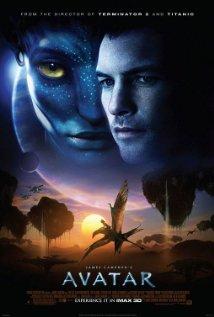
Movie Info
Movie Year:
Cast:
Sam Worthington
,
Giovanni Ribisi
,
Wes Studi
,
Laz Alonso
,
Zoe Saldana
,
Misty Rosas
,
Stephen Lang
,
Dileep Rao
,
Sigourney Weaver
,
Michelle Rodriguez
,
Jason Whyte
,
Matt Gerald
,
Sean Anthony Moran
,
Bob Peterson
,
Scott Lawrence
,
Ale Dugas
,
CCH Pounder
,
Ilram Choi
,
Peter Mensah
,
Nicole Dionne
Screenplay:
Genre:
Action/Adventure
Other
Horror/Suspense
Television
Romance
Sci-Fi/Fantasy
Thriller
Animation
Comedy
Documentary
Drama
Kids/Family
Studio:
DVD Release:
2010/04/22
Theater Release:
2009/12/18
Blu-ray Release:
2010/04/22
Blu-ray 3D Release:
No release information.
DVD Release:
(ex. 2002/10/21)
Synopsis:
Tagline:
An All New World Awaits
Jan 05, 2010
"You've never experienced anything like it," gushed the LA Times about "Avatar," James Cameron's motion-capture extravaganza. And if you aren't a Came ...
"You've never experienced anything like it," gushed the LA Times about "Avatar," James Cameron's motion-capture extravaganza. And if you aren't a Cameron connoisseur or an avid gamer, you might put all stock in the novelty of cutting-edge illusion and feel just as effusive. I may not have experienced the marvels of "Avatar" bundled together into one parcel until now, or its "game-changing" 3D effects, but I still felt like I'd been down this road before. Not to say I wasn't left breathless by the film's look or thrilled by its outstanding action sequences; if I checked my watch once or twice, it wasn't during the climactic battle between airships and dragon-mounted archers, which swept me up into a gleeful place six feet above my chair. "Avatar" is for the eyes and breast. It's achingly beautiful, a 70mm version of "World of Warcraft's" loveliest zone, with its humid, violet luminescence, its drifting tendrils, its spots of blood-red, and its alien fungal forms. But it's not an original. It's a fantasy realm we've seen as far back as American McGee's "Alice," and Cameron shouldn't be faulted for grasping that realm's allure and reproducing it in its finest form to date. There's no reason why the visual feast of better video game art direction shouldn't be adapted for the multiplex. It's evident that Cameron himself feels this way. He suggests as much in the movie's title and premise.
"Avatar" is set in the future, after humans have de-greened the Earth and mastered intergalactic flight. Big industry has enlisted scientists and the US military to help them colonize Pandora and extract its precious ore. The new planet presents an old complication, however: the biggest deposit lies under territory inhabited by a tribe of indigenous Na'vi (a half-anagramic play on native), whose size, prowess and near-indestructible bones hinder the humans' quest. Enter Grace Augustine (Sigourney Weaver), whose Avatar program is expected to level the playing field by inserting the consciousness of human operatives into bodies similar to those of the locals. Strong, feline, and ten feet tall, the avatars take getting used to, but they're perfectly adapted to Pandora's environment. Thrust into one of these bodies is Jake Sully (Sam Worthington), a paraplegic marine who's assigned the avatar genetically designed for a dead brother. He makes half-hearted statements about accepting the mission in exchange for spinal surgery, but we glean his real motive; the big blue bodies are the stuff of human dreams. Sully yearns to do what many of us wish we can: experience unlimited physical intelligence in a form just shy of immortal.
Some walk away from "Avatar" exhilarated by its action, realm and special effects. Others are left disappointed by its clichés, its eye-rolling dialogue and its amateur-hour narrative. I get where both types of viewer are coming from, because I experienced both sensations in equal measure. This review is neither a rave nor a pan, but a dig-in-my-heels demand for better. I can forgive a film a lot if the visuals are fat enough, but I expected more from a Cameron SF/action movie, especially one that's been gestating for over a decade. The man who (along with John McTiernan) defined the American action movie in the 80s and 90s needs to bring it to the next level in 2009. Instead we're handed stale devices that worked in "Terminator," 'T2,' "Aliens" and "The Abyss," but which have lost impact after years of mimicry: the despotic military official from "The Abyss" and the oily corporate henchman from "Aliens"; a battle-royal in a steel monkey-suit (Ripley's "Aliens" showdown is reversed, with the baddie in the suit and the hero in the alien's form); the female genius whose creation goes awry (Grace is a ringer for Lindsey in "The Abyss") and the plucky female pilot who navigates like a dream but still ends up dead; Sigourney freaking Weaver making her entrance out of a cryonic sleeping pod (Cameron's only moment of self-awareness falls flat); and the Destruction of the Big Thing—not an ocean liner or submarine mining rig this time, but a gigantic tree that relies on the same sound-effect as the Titanic and the rig when it keels. Cameron even recycles dialogue. We hear double when Grace calls Colonel Quaritch "Ranger Rick" as she scolds him about ethics (Lindsey calls Lt. Coffey "Roger Ramjet" during the same set-up in "The Abyss"). We expect a degree of consistency from our directors, but Cameron uses old inventions like a crutch that can't leverage him out of a serious narrative rut. There's a difference between a signature and a do-over, and Cameron's self-imitation is parodic. There's just too much of it.
What little wonder exists in "Avatar"—besides the larger wonder of its visual effects—resides in its mythology. Nothing much is new here, but that's okay when you're dealing in myth; that's how these frameworks function. Still, it takes a special kind of hack to turn a venerable archetype (Sully is yet another Chosen One) into a blundering cliché that struggles to win hearts in our post-colonial era. Pandora's neural network, which connects goddess and ancestor to animal and vegetable, is rendered so beautifully that Cameron's patronizing, mangled politics can almost be forgiven. The Na'vi bind themselves to their mounts with braids that turn out to be external auxiliary spinal columns of a sort (powerful ones that appeal to the chair-bound Sully). This bond between life forms is supposed to celebrate Mother Earth philosophies, but Cameron gaffs his political correctness when Sully uses colonial words like "You're mine!" when he claims his mount. The film is riddled with these missteps that constantly undermine what little invention exists onscreen. Cameron is being praised for his attention to detail (Pandora's world, the Na'vi tongue), but his focus falls short where it counts. He neglects details of character, conversation and theme, the latter of which is all over the place, poxed by lazy contradiction, knocked aside in the filmmakers' haste to hop us up on their eye-candy. Their "game-changing" line rings hollow if the meat remains the same or—worse—falls short of Cameron's earlier dedication to story and character, which made Sarah Connor and Bud Brigman substantial enough.
I haven't detailed the project's whiz-bang technology or its problematic politics, since both these subjects have been treated ad nauseam elsewhere (a little Google-fu will do you, if you're so inclined). I went into "Avatar" as a fan of Cameron's SF/action films, expectations taut, so that's the fairest way to approach this review. That inner fan was let down. The gamer in me was also intrigued and somewhat more mollified—and to bring up video games in the same breath as "Avatar" is no insult. In fact, the concept of games and their place in our culture is one of the few motifs Cameron nails, and it partially salvaged the film for me. The imagery of places that delight me in another "life" (the oozy purples of WoW's Zangarmarsh and the floating mountains-with-waterfalls of Nagrand) connect not accidentally to the movie's concept. Disabled Sully represents earthbound us, and his obsession with Pandora—his eagerness to return to the fantastic blue body of his avatar each day—has all the hallmarks of gamer addiction. Grace chides him for neglecting to eat and bathe; Sully's too eager to earn rep with the Na'vi and graduate from mount to flying mount to epic flying mount (WoW players spot the pattern and know his satisfaction). It's deliberate. We're supposed to think of video games when we hear the title of Cameron's movie and revel in Sully's thrills. But those of us who need narrative substance in our films to make up for the thinness of animated faces onscreen—who can't get past the lack of texture that CGI continues to present—feel shortchanged. Between the gut-churning speeches, the conventional soundtrack, the ham-fisted anti-oil, anti-imperialism and anti-Iraq messaging, and the recycled everything, there's not much sophistication here, and not much beyond the 3D effects or the realm itself to earn the finicky viewer's kudos.
==Written by Ranylt Richildis==
==From: In Review Online (www.inreviewonline.com)==
"Avatar" is set in the future, after humans have de-greened the Earth and mastered intergalactic flight. Big industry has enlisted scientists and the US military to help them colonize Pandora and extract its precious ore. The new planet presents an old complication, however: the biggest deposit lies under territory inhabited by a tribe of indigenous Na'vi (a half-anagramic play on native), whose size, prowess and near-indestructible bones hinder the humans' quest. Enter Grace Augustine (Sigourney Weaver), whose Avatar program is expected to level the playing field by inserting the consciousness of human operatives into bodies similar to those of the locals. Strong, feline, and ten feet tall, the avatars take getting used to, but they're perfectly adapted to Pandora's environment. Thrust into one of these bodies is Jake Sully (Sam Worthington), a paraplegic marine who's assigned the avatar genetically designed for a dead brother. He makes half-hearted statements about accepting the mission in exchange for spinal surgery, but we glean his real motive; the big blue bodies are the stuff of human dreams. Sully yearns to do what many of us wish we can: experience unlimited physical intelligence in a form just shy of immortal.
Some walk away from "Avatar" exhilarated by its action, realm and special effects. Others are left disappointed by its clichés, its eye-rolling dialogue and its amateur-hour narrative. I get where both types of viewer are coming from, because I experienced both sensations in equal measure. This review is neither a rave nor a pan, but a dig-in-my-heels demand for better. I can forgive a film a lot if the visuals are fat enough, but I expected more from a Cameron SF/action movie, especially one that's been gestating for over a decade. The man who (along with John McTiernan) defined the American action movie in the 80s and 90s needs to bring it to the next level in 2009. Instead we're handed stale devices that worked in "Terminator," 'T2,' "Aliens" and "The Abyss," but which have lost impact after years of mimicry: the despotic military official from "The Abyss" and the oily corporate henchman from "Aliens"; a battle-royal in a steel monkey-suit (Ripley's "Aliens" showdown is reversed, with the baddie in the suit and the hero in the alien's form); the female genius whose creation goes awry (Grace is a ringer for Lindsey in "The Abyss") and the plucky female pilot who navigates like a dream but still ends up dead; Sigourney freaking Weaver making her entrance out of a cryonic sleeping pod (Cameron's only moment of self-awareness falls flat); and the Destruction of the Big Thing—not an ocean liner or submarine mining rig this time, but a gigantic tree that relies on the same sound-effect as the Titanic and the rig when it keels. Cameron even recycles dialogue. We hear double when Grace calls Colonel Quaritch "Ranger Rick" as she scolds him about ethics (Lindsey calls Lt. Coffey "Roger Ramjet" during the same set-up in "The Abyss"). We expect a degree of consistency from our directors, but Cameron uses old inventions like a crutch that can't leverage him out of a serious narrative rut. There's a difference between a signature and a do-over, and Cameron's self-imitation is parodic. There's just too much of it.
What little wonder exists in "Avatar"—besides the larger wonder of its visual effects—resides in its mythology. Nothing much is new here, but that's okay when you're dealing in myth; that's how these frameworks function. Still, it takes a special kind of hack to turn a venerable archetype (Sully is yet another Chosen One) into a blundering cliché that struggles to win hearts in our post-colonial era. Pandora's neural network, which connects goddess and ancestor to animal and vegetable, is rendered so beautifully that Cameron's patronizing, mangled politics can almost be forgiven. The Na'vi bind themselves to their mounts with braids that turn out to be external auxiliary spinal columns of a sort (powerful ones that appeal to the chair-bound Sully). This bond between life forms is supposed to celebrate Mother Earth philosophies, but Cameron gaffs his political correctness when Sully uses colonial words like "You're mine!" when he claims his mount. The film is riddled with these missteps that constantly undermine what little invention exists onscreen. Cameron is being praised for his attention to detail (Pandora's world, the Na'vi tongue), but his focus falls short where it counts. He neglects details of character, conversation and theme, the latter of which is all over the place, poxed by lazy contradiction, knocked aside in the filmmakers' haste to hop us up on their eye-candy. Their "game-changing" line rings hollow if the meat remains the same or—worse—falls short of Cameron's earlier dedication to story and character, which made Sarah Connor and Bud Brigman substantial enough.
I haven't detailed the project's whiz-bang technology or its problematic politics, since both these subjects have been treated ad nauseam elsewhere (a little Google-fu will do you, if you're so inclined). I went into "Avatar" as a fan of Cameron's SF/action films, expectations taut, so that's the fairest way to approach this review. That inner fan was let down. The gamer in me was also intrigued and somewhat more mollified—and to bring up video games in the same breath as "Avatar" is no insult. In fact, the concept of games and their place in our culture is one of the few motifs Cameron nails, and it partially salvaged the film for me. The imagery of places that delight me in another "life" (the oozy purples of WoW's Zangarmarsh and the floating mountains-with-waterfalls of Nagrand) connect not accidentally to the movie's concept. Disabled Sully represents earthbound us, and his obsession with Pandora—his eagerness to return to the fantastic blue body of his avatar each day—has all the hallmarks of gamer addiction. Grace chides him for neglecting to eat and bathe; Sully's too eager to earn rep with the Na'vi and graduate from mount to flying mount to epic flying mount (WoW players spot the pattern and know his satisfaction). It's deliberate. We're supposed to think of video games when we hear the title of Cameron's movie and revel in Sully's thrills. But those of us who need narrative substance in our films to make up for the thinness of animated faces onscreen—who can't get past the lack of texture that CGI continues to present—feel shortchanged. Between the gut-churning speeches, the conventional soundtrack, the ham-fisted anti-oil, anti-imperialism and anti-Iraq messaging, and the recycled everything, there's not much sophistication here, and not much beyond the 3D effects or the realm itself to earn the finicky viewer's kudos.
==Written by Ranylt Richildis==
==From: In Review Online (www.inreviewonline.com)==
Dec 23, 2009
With The Terminator, its sequel T2: Judgement Day, The Abyss, and Aliens, James Cameron solidified himself as one of the all-time great directors. He' ...
With The Terminator, its sequel T2: Judgement Day, The Abyss, and Aliens, James Cameron solidified himself as one of the all-time great directors. He's still remembered for those movies and rightly so. But in the late '90s came a juggernaut of a movie, both financially and critically — the historical romantic blockbuster, Titanic. It made $1.8 billion at the worldwide box office and won 11 out of its 14 Oscar nominations.
Since then, Cameron hasn't directed a feature film (he's mostly been making documentaries on the depths of the sea). However, before he even made Titanic, Cameron had a vision for a film set on another world and filled with amazing creatures. That movie was Avatar. At the time the technology didn't exist to bring his ideas to life, and so in the back of his mind it stayed for a decade and half.
However, as the end of the first decade of the 21st century approached, the technology had finally caught up with Cameron, and he was able to make his vision come true. The hype leading up to Avatar was monumental, with proclamations of it being the greatest innovation in filmmaking since celluloid. That alone is a lot to live up to, and I'm happy to report it does.
First, the plot: Sam Worthington (Terminator Salvation) plays Jake Sully, a paraplegic ex-Marine who one day gets the opportunity to experience living on another planet through the use of a genetically modified body known as an Avatar. The planet he'll be going to is Pandora, a world filled with an abundance of diverse and unknown creatures, including an indigenous race called the Na'Vi. Jake's mission is to learn the Na'Vis' ways of life and feed the info back to the humans off-planet. But once there, Jake starts to see life from the perspective of the Na'Vi and begins to disagree with the humans' prerogative.
This isn't "just another movie," one that you should maybe catch on the odd day off. This is an event, one that needs to be experienced on the big screen, in 3D, the way it was meant to be. Just simply looking at what's on screen for the whole 161 minutes (a runtime which absolutely flies by) is jaw-dropping, from the look of the Na'Vi themselves (who, out of context, look strange, but are completely acceptable as characters within the movie) to the wildlife that makes up the planet.
That's perhaps the biggest joy of Avatar: just experiencing this "other world" that Cameron has created. This film has as a selling point the fact that it's not a sequel, a prequel, a spin-off or based off of any sort of source material (although Cameron is no doubt been influenced by sci-fi material of all kinds). This is an original work, from the mind of the man who brought us greats like Aliens and Terminator 2. The scenes, for example, which involve the camera swooping through the jungle, following floating white "insects," or watching the Na'Vi gracefully and assuredly make their way through the jungle to practice climbing are all gorgeous to look at. And what makes them so are not just the vibrant colours or sharp visuals, but the way in which everything on screen has been carefully mapped out and detailed. You feel as if the camera were to suddenly swing round and zoom in you'd see every little pattern on the nearest tree or insect's wing.
The casting of Worthington in the lead role just solidifies him as the leading man of the minute. Having already starred in the blockbuster Terminator Salvation (coincidentally, the fourth instalment in a franchise that Cameron kicked off in the mid-'80s), and the upcoming Clash of the Titans, I think it's safe to say this guy is going places. He's got a certain everyman presence about him that makes him relatable and someone you can really root for. In the fourth Terminator he was able to make a half-man, half-machine feel totally empathetic, and here, even in his Avatar body (which weirdly looks like him) he's able to draw so much humanity from it all. He's doing very well for himself and I wish him nothing but continued success.
Surrounding him is an array of great actors and there isn't a weak link in the chain: Ripley herself, Sigourney Weaver, plays the tree-hugging scientist who sympathizes with the Na'Vi; Giovanni Ribisi plays the money/power-hungry head of the operation to invade Pandora; and Stephen Lang is brilliant as the "shoot first, think later" Colonel Quaritch, a man who would love nothing more than to kill every one of the Na'Vi ("they are very hard to kill").
But much like Cameron's Titanic or Terminator 2, one of the major highlights of Avatar are the visual effects. And when the hype purported it was a step forward in special effects technology that wasn't an overstatement — this really is revolutionary stuff that Cameron has utilized here, and in fact the man himself even developed a new camera to get exactly what he wanted up there on the screen. The 3D here is used perfectly, enhancing the overall experience of the movie as opposed to just being there to have things jump out of the screen at you just for the sake of it, as most 3D movies do (Beowulf, Coraline, My Bloody Valentine, on and on).
Amazingly, as much as the movie is about the visuals, Cameron still manages to keep things grounded and even, at times, genuinely emotional. From the outside looking in, the blue Na'Vi creatures should be as alien to us as their appearance, but Cameron makes them as much human as the human characters themselves (often even more so). Zoe Saldana (who played the new Uhura in this summer's excellent Star Trek reboot) stands out in particular as the female Na'Vi who Jake falls for whilst in his Avatar body.
However, emotionality aside, it wouldn't be a James Cameron movie without several big action set pieces. One big sequence at the end comes particularly to mind — awe-inspiring doesn't even begin to cover it. There's as much detail in that one scene — bullets flying everywhere, ships exploding, arrows shooting, several hundred characters on screen at any one time — than I've ever seen in a movie.
Of course, all of this is possible because of the film's mammoth budget of approximately $300 million ($500 million has even been rumoured, if you include promotional budgets and so forth), which would make it the most expensive movie ever made. The question of whether it's worth the money or not is debatable, but the question of whether it will make its money back at the box office has a much clearer answer: yes. Although I don't think it will have the all-time record-breaking success of Titanic (it just doesn't have as much of a universal appeal as that did, particularly not to most female audiences), I have no doubt that people will be going out in droves to experience it on the big screen.
If I had to stretch to anything I thought was a fault of this movie, it would maybe be the story. It's not particularly original (someone aptly described it as "Dances With Wolves a few centuries into the future") and it's sometime easy to see where things are going. Also, as mentioned, a few of the human characters are a little bit two-dimensional. But those are nitpicks on my part, and everything else was so great they were easy to forgive and overlook.
Needless to say I absolutely loved this movie, not just because of spectacular set pieces and overall epic nature, but the visuals (and the technology employed to achieve them) are absolutely stunning. It's one of those movies that if you paused it at any point, you'd have an image ready to be framed and hung up on the wall. This — the return of James Cameron after 12 years away from the director's chair — is modern day filmmaking at its biggest, boldest, and most visually stunning.
Much like the blockbuster juggernaut of last year that was The Dark Knight, Avatar had an immeasurable amount of hype built up around it, but I'm glad to say it lives up to it. Mr. Cameron has delivered; he's still very much got it.
==Written by Ross Miller==
==From: Movie World (www.movie-world.moonfruit.com)==
Since then, Cameron hasn't directed a feature film (he's mostly been making documentaries on the depths of the sea). However, before he even made Titanic, Cameron had a vision for a film set on another world and filled with amazing creatures. That movie was Avatar. At the time the technology didn't exist to bring his ideas to life, and so in the back of his mind it stayed for a decade and half.
However, as the end of the first decade of the 21st century approached, the technology had finally caught up with Cameron, and he was able to make his vision come true. The hype leading up to Avatar was monumental, with proclamations of it being the greatest innovation in filmmaking since celluloid. That alone is a lot to live up to, and I'm happy to report it does.
First, the plot: Sam Worthington (Terminator Salvation) plays Jake Sully, a paraplegic ex-Marine who one day gets the opportunity to experience living on another planet through the use of a genetically modified body known as an Avatar. The planet he'll be going to is Pandora, a world filled with an abundance of diverse and unknown creatures, including an indigenous race called the Na'Vi. Jake's mission is to learn the Na'Vis' ways of life and feed the info back to the humans off-planet. But once there, Jake starts to see life from the perspective of the Na'Vi and begins to disagree with the humans' prerogative.
This isn't "just another movie," one that you should maybe catch on the odd day off. This is an event, one that needs to be experienced on the big screen, in 3D, the way it was meant to be. Just simply looking at what's on screen for the whole 161 minutes (a runtime which absolutely flies by) is jaw-dropping, from the look of the Na'Vi themselves (who, out of context, look strange, but are completely acceptable as characters within the movie) to the wildlife that makes up the planet.
That's perhaps the biggest joy of Avatar: just experiencing this "other world" that Cameron has created. This film has as a selling point the fact that it's not a sequel, a prequel, a spin-off or based off of any sort of source material (although Cameron is no doubt been influenced by sci-fi material of all kinds). This is an original work, from the mind of the man who brought us greats like Aliens and Terminator 2. The scenes, for example, which involve the camera swooping through the jungle, following floating white "insects," or watching the Na'Vi gracefully and assuredly make their way through the jungle to practice climbing are all gorgeous to look at. And what makes them so are not just the vibrant colours or sharp visuals, but the way in which everything on screen has been carefully mapped out and detailed. You feel as if the camera were to suddenly swing round and zoom in you'd see every little pattern on the nearest tree or insect's wing.
The casting of Worthington in the lead role just solidifies him as the leading man of the minute. Having already starred in the blockbuster Terminator Salvation (coincidentally, the fourth instalment in a franchise that Cameron kicked off in the mid-'80s), and the upcoming Clash of the Titans, I think it's safe to say this guy is going places. He's got a certain everyman presence about him that makes him relatable and someone you can really root for. In the fourth Terminator he was able to make a half-man, half-machine feel totally empathetic, and here, even in his Avatar body (which weirdly looks like him) he's able to draw so much humanity from it all. He's doing very well for himself and I wish him nothing but continued success.
Surrounding him is an array of great actors and there isn't a weak link in the chain: Ripley herself, Sigourney Weaver, plays the tree-hugging scientist who sympathizes with the Na'Vi; Giovanni Ribisi plays the money/power-hungry head of the operation to invade Pandora; and Stephen Lang is brilliant as the "shoot first, think later" Colonel Quaritch, a man who would love nothing more than to kill every one of the Na'Vi ("they are very hard to kill").
But much like Cameron's Titanic or Terminator 2, one of the major highlights of Avatar are the visual effects. And when the hype purported it was a step forward in special effects technology that wasn't an overstatement — this really is revolutionary stuff that Cameron has utilized here, and in fact the man himself even developed a new camera to get exactly what he wanted up there on the screen. The 3D here is used perfectly, enhancing the overall experience of the movie as opposed to just being there to have things jump out of the screen at you just for the sake of it, as most 3D movies do (Beowulf, Coraline, My Bloody Valentine, on and on).
Amazingly, as much as the movie is about the visuals, Cameron still manages to keep things grounded and even, at times, genuinely emotional. From the outside looking in, the blue Na'Vi creatures should be as alien to us as their appearance, but Cameron makes them as much human as the human characters themselves (often even more so). Zoe Saldana (who played the new Uhura in this summer's excellent Star Trek reboot) stands out in particular as the female Na'Vi who Jake falls for whilst in his Avatar body.
However, emotionality aside, it wouldn't be a James Cameron movie without several big action set pieces. One big sequence at the end comes particularly to mind — awe-inspiring doesn't even begin to cover it. There's as much detail in that one scene — bullets flying everywhere, ships exploding, arrows shooting, several hundred characters on screen at any one time — than I've ever seen in a movie.
Of course, all of this is possible because of the film's mammoth budget of approximately $300 million ($500 million has even been rumoured, if you include promotional budgets and so forth), which would make it the most expensive movie ever made. The question of whether it's worth the money or not is debatable, but the question of whether it will make its money back at the box office has a much clearer answer: yes. Although I don't think it will have the all-time record-breaking success of Titanic (it just doesn't have as much of a universal appeal as that did, particularly not to most female audiences), I have no doubt that people will be going out in droves to experience it on the big screen.
If I had to stretch to anything I thought was a fault of this movie, it would maybe be the story. It's not particularly original (someone aptly described it as "Dances With Wolves a few centuries into the future") and it's sometime easy to see where things are going. Also, as mentioned, a few of the human characters are a little bit two-dimensional. But those are nitpicks on my part, and everything else was so great they were easy to forgive and overlook.
Needless to say I absolutely loved this movie, not just because of spectacular set pieces and overall epic nature, but the visuals (and the technology employed to achieve them) are absolutely stunning. It's one of those movies that if you paused it at any point, you'd have an image ready to be framed and hung up on the wall. This — the return of James Cameron after 12 years away from the director's chair — is modern day filmmaking at its biggest, boldest, and most visually stunning.
Much like the blockbuster juggernaut of last year that was The Dark Knight, Avatar had an immeasurable amount of hype built up around it, but I'm glad to say it lives up to it. Mr. Cameron has delivered; he's still very much got it.
==Written by Ross Miller==
==From: Movie World (www.movie-world.moonfruit.com)==
Jan 06, 2012
James Cameron’s Avatar, quickly being called one of the greatest films of all time, has already placed itself as the highest grossing film of all time ...
James Cameron’s Avatar, quickly being called one of the greatest films of all time, has already placed itself as the highest grossing film of all time (not considering inflation). The big questions are: Is it worth the hype? Is it really that good? Isn’t it just glorifying the use of CGI while ignoring the basics of film making? No doubt those questions will long be debated, but one thing is certain for me after viewing this piece: it rocks!
Now I’m not going to jump on the wagon and call this the greatest film of all time, but I can confidently say after viewing this imaginative masterpiece in 3D that it will be one of the most remembered films for a long time to come. Yes, the main things that stick out about this film are the spectacular visuals. After putting off seeing this film and doubting the significance of seeing it in 3D, I am glad that I did choose to see it in 3D in the end. The fantastical world of Pandora was purely stunning and the extremely detailed 3D made the viewer seem as if they were experiencing the world first-hand.
Anti-CGI fanboys bash the film for its large use of the computer effects. While normally I have mixed feelings about use of CGI, I think that the fantastical nature of Cameron’s vision simply required that much detail that couldn’t have been replicated using more traditional approaches. The effects in this movie are truly a work of art, make no mistake. Rather than replace a human’s real and emotional performance, the effects in Avatar enhance them to a certain level required by the unique nature of the creatures and environments.
Regarding the story, we have a pretty straight forward plot that is nothing we haven’t really seen before. Many comparisons have already been drawn and debates have been staged involving the “sources of inspiration” for this movie. In this day and age it’s quite difficult, if not impossible, to find true originality when it comes to movies. However, I think that James Cameron did a great job taking something that’s been seen more than once and putting his own unique spin on it and taking it to a whole new level.
For those not already familiar, the story follows a paraplegic Marine named Jake Sully, played by Sam Worthington. Sully enrolls with a group of scientists led by Dr. Augustine (Sigourney Weaver) to serve as military protection from the Na’vi, the hostile natives of Pandora. Behind the scenes, Col. Miles Quaritch, played by Stephen Lang, propositions Jake to infiltrate the Na’vi so that they can take advantage of a precious material housed beneath the Na’vi’s land. With the promise of getting his legs back, Jake accepts.
Stripping the film down to its bare components, the film isn’t absolutely perfect, but is not bad by any means either. The acting is fairly solid all around. At times though it seemed that Worthington had a little trouble controlling his Australian accent, but this wasn’t overly noticeable. Zoe Saldana did a fabulous job playing Neytiri, princess of the Na’vi Omaticaya Clan. As a matter of fact, all of the actors playing Na’vi characters did a brilliant job as their performances were not hindered one bit by CGI. I felt the film was very well cast, even down to the extras. All of the actors fit their characters’ persona. The dialog however was not quite as strong. Most of the time it was very generic, even slightly predictable. Either way, there was plenty else going on that made up for some of these flaws. Would the film be as strong and be able to achieve the same effect if any particular aspect had been done a different way? Probably not.
I entered this film expecting some excellent visuals and an average plot. I ended up being thoroughly surprised with the visuals as no attention to detail was spared. The film had a scary ability to make the viewer feel like part of its world. The story for me was predictable for the most part, but even though it lacked a bit, Cameron really did make it a thing of his own. Through the 3 hour runtime there’s never a dull moment, and I found myself really feeling for the characters and caring about what happened to them. For me in the end I didn’t feel like it was the best movie ever made, but surely one of the most memorable. I would compare it to the way Jurassic Park made me feel when it came out, as it really made the viewer believe what they were seeing and become in love with the world being presented.
You really have to see it to judge it for yourself, but I recommend doing so by watching it in the best quality possible to get the intended effect. Sci-fi and CGI still may not be everyone’s bag for one reason or another, but those who understand and appreciate the two will really admire this film and leave the theater with a great feeling.
==Written by Nicolas ==
==From: Critic Nic (www.criticnic.com)==
Now I’m not going to jump on the wagon and call this the greatest film of all time, but I can confidently say after viewing this imaginative masterpiece in 3D that it will be one of the most remembered films for a long time to come. Yes, the main things that stick out about this film are the spectacular visuals. After putting off seeing this film and doubting the significance of seeing it in 3D, I am glad that I did choose to see it in 3D in the end. The fantastical world of Pandora was purely stunning and the extremely detailed 3D made the viewer seem as if they were experiencing the world first-hand.
Anti-CGI fanboys bash the film for its large use of the computer effects. While normally I have mixed feelings about use of CGI, I think that the fantastical nature of Cameron’s vision simply required that much detail that couldn’t have been replicated using more traditional approaches. The effects in this movie are truly a work of art, make no mistake. Rather than replace a human’s real and emotional performance, the effects in Avatar enhance them to a certain level required by the unique nature of the creatures and environments.
Regarding the story, we have a pretty straight forward plot that is nothing we haven’t really seen before. Many comparisons have already been drawn and debates have been staged involving the “sources of inspiration” for this movie. In this day and age it’s quite difficult, if not impossible, to find true originality when it comes to movies. However, I think that James Cameron did a great job taking something that’s been seen more than once and putting his own unique spin on it and taking it to a whole new level.
For those not already familiar, the story follows a paraplegic Marine named Jake Sully, played by Sam Worthington. Sully enrolls with a group of scientists led by Dr. Augustine (Sigourney Weaver) to serve as military protection from the Na’vi, the hostile natives of Pandora. Behind the scenes, Col. Miles Quaritch, played by Stephen Lang, propositions Jake to infiltrate the Na’vi so that they can take advantage of a precious material housed beneath the Na’vi’s land. With the promise of getting his legs back, Jake accepts.
Stripping the film down to its bare components, the film isn’t absolutely perfect, but is not bad by any means either. The acting is fairly solid all around. At times though it seemed that Worthington had a little trouble controlling his Australian accent, but this wasn’t overly noticeable. Zoe Saldana did a fabulous job playing Neytiri, princess of the Na’vi Omaticaya Clan. As a matter of fact, all of the actors playing Na’vi characters did a brilliant job as their performances were not hindered one bit by CGI. I felt the film was very well cast, even down to the extras. All of the actors fit their characters’ persona. The dialog however was not quite as strong. Most of the time it was very generic, even slightly predictable. Either way, there was plenty else going on that made up for some of these flaws. Would the film be as strong and be able to achieve the same effect if any particular aspect had been done a different way? Probably not.
I entered this film expecting some excellent visuals and an average plot. I ended up being thoroughly surprised with the visuals as no attention to detail was spared. The film had a scary ability to make the viewer feel like part of its world. The story for me was predictable for the most part, but even though it lacked a bit, Cameron really did make it a thing of his own. Through the 3 hour runtime there’s never a dull moment, and I found myself really feeling for the characters and caring about what happened to them. For me in the end I didn’t feel like it was the best movie ever made, but surely one of the most memorable. I would compare it to the way Jurassic Park made me feel when it came out, as it really made the viewer believe what they were seeing and become in love with the world being presented.
You really have to see it to judge it for yourself, but I recommend doing so by watching it in the best quality possible to get the intended effect. Sci-fi and CGI still may not be everyone’s bag for one reason or another, but those who understand and appreciate the two will really admire this film and leave the theater with a great feeling.
==Written by Nicolas ==
==From: Critic Nic (www.criticnic.com)==
Studio: Tcfhe Release Date: 11/16/2010 Rating: Pg13
Movie Disc Details
Disc Version:
Runtime:
97
DVD Region:
2, 4
Disc Type:
DVD
Aspect Ratio:
16:9
Video Format:
MPEG-2
Parental Control:
1
Video Signal:
PAL
Layers:
1
Subtitles:
English (United States)
Dutch (Netherlands)
Bulgarian (Bulgaria)
Sound Mix:
Dolby Digital
DTS